


In the world of navigation and geospatial technologies, GPS (Global Positioning System) has become an essential tool for everything from driving directions to surveying land. However, not all GPS systems are created equal. While standard GPS offers basic positioning capabilities, more advanced systems like rtk gps (Real-Time Kinematic GPS) provide much higher levels of accuracy. In this article, we’ll explore the differences between RTK GPS vs. Standard GPS, what each system offers, and when you might need one over the other.
What is Standard GPS?
Standard GPS, also known as Conventional GPS, uses a network of satellites that send signals to receivers on the ground. These signals help determine the position of the receiver by triangulating the distances between the receiver and multiple satellites.
Key Features of Standard GPS:
- Accuracy: Standard GPS offers accuracy typically within 5 to 10 meters. This is adequate for most everyday applications like navigation in vehicles or smartphones.
- Availability: Standard GPS is available in nearly all consumer-grade devices, including smartphones, handheld devices, and car navigation systems.
- Cost: Since it’s widely used in consumer devices, Standard GPS is cost-effective and readily accessible.
Limitations of Standard GPS:
- Accuracy Issues: The main drawback of Standard GPS is its relatively low accuracy, which can be problematic in applications that require precise positioning.
- Signal Interference: Weather conditions, tall buildings, and other obstacles can interfere with GPS signals, reducing its effectiveness.
What is RTK GPS?
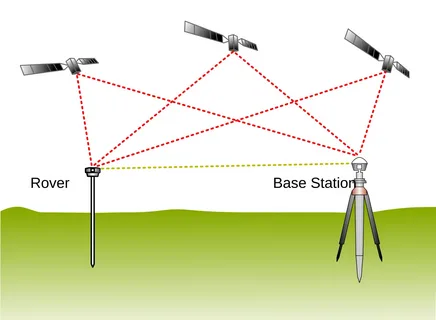
RTK GPS (Real-Time Kinematic GPS) is an advanced form of GPS that significantly enhances the accuracy of standard GPS systems. It uses a base station (a fixed reference point) and a rover (a mobile receiver) to achieve real-time corrections, allowing for positioning accuracy to reach centimeters rather than meters.
Key Features of RTK GPS:
- High Precision: RTK GPS can achieve positioning accuracy down to 1-2 centimeters. This makes it ideal for applications where precise measurements are essential.
- Real-Time Corrections: The base station continuously sends corrections to the rover, improving the quality of data in real time.
- Reliability: RTK GPS is less affected by atmospheric conditions like ionospheric delays, making it more reliable for high-precision applications.
Common Uses of RTK GPS:
- Surveying: RTK GPS is a vital tool in land surveying, where exact measurements are crucial for legal and construction purposes.
- Agriculture: Farmers use RTK GPS for precision farming, ensuring that equipment like tractors or drones follow accurate paths to optimize planting, irrigation, and harvesting.
- Autonomous Vehicles: RTK GPS is used in self-driving cars and robotics for precise navigation and obstacle avoidance.
RTK GPS vs. Standard GPS: The Key Differences
1. Accuracy
The most significant difference between RTK GPS vs. Standard GPS is the level of accuracy. While Standard GPS offers accuracy within 5 to 10 meters, RTK GPS can achieve centimeter-level precision, making it far more suitable for high-precision tasks.
2. Cost
RTK GPS systems are much more expensive than Standard GPS. This price difference comes from the advanced technology, specialized equipment, and infrastructure (base stations) required for RTK systems.
3. Applications
Standard GPS is used for everyday navigation, mapping, and location-based services. On the other hand, RTK GPS is designed for industries that demand precise positioning, such as land surveying, construction, and agriculture.
4. Infrastructure
RTK GPS requires a network of ground-based base stations that send correction signals to the rover for real-time accuracy. Standard GPS, in contrast, only requires a GPS receiver and satellites, making it simpler but less accurate.
When to Use RTK GPS vs. Standard GPS
While both systems have their uses, choosing between RTK GPS and Standard GPS depends on your needs.
- Use Standard GPS if you need general location data for navigation, like driving, hiking, or tracking. It’s enough for most casual and non-technical uses.
- Use RTK GPS if you require high precision for professional purposes like surveying, construction, or precision agriculture. The added accuracy is worth the investment in these fields.
Conclusion
In the debate of RTK GPS vs. Standard GPS, the choice ultimately comes down to the level of accuracy you need. While Standard GPS suffices for everyday applications, RTK GPS is the go-to solution for high-precision tasks that demand centimeter-level accuracy. Understanding the differences between the two systems can help you select the right one based on your specific requirements, whether you’re navigating through a city or conducting a topographical survey.
